Let me introduce you to Andrés Rojas. Every couple of weeks, Andrés hikes deep in the Colombian rainforest, passing through mud and swarms of mosquitoes. Not for adventure, definitely not for fun, but to do his job. He needs to replace batteries and change memory cards of camera traps and bioacoustic devices. This is the critical infrastructure of conservation science today. People like Andrés are heroes and thanks to their effort, they have saved species from the brink of extinction.
There are 200,000 conservationists in the world, and all of them share one thing in common. To do their job, they need data. But we live in an interesting world where we have refrigerators that can text you if you’re running out of milk, [but] conservationists still need to hike for days just to see if an animal passed by. Conservation today is heroic, is needed, but is painfully slow.
Last year I was proudly presenting at a biodiversity conference some of our latest AI models. But it was in fact a very humbling moment. Because, when presenting to them, I realized that even though they were using our models, once you understood the hassle that they needed to go through, from installing these devices to collecting the data to eventually [having] time to analyze it, I realized that our solutions were not making such big of a difference. I realized that in order for us to make a difference, we need to completely reinvent how data works in biodiversity.
This is why we developed SPARROW. SPARROW stands for Solar-Powered Acoustic Remote Recording Observation Watch. SPARROW is a small network of devices that act as a hub in the middle of nature, connecting to camera traps, acoustic devices, sensors, processing the information using solar power. Processing the information on the edge using a low-voltage GPU. Sending results back using a low-orbit satellite. With SPARROW, you install it once, you no longer need to hike to collect data, you can connect online and see the data real-time.
One of my biggest lessons in life is the realization that we, as humans, are addicted to complexity. We like complex projects and we like complex things. This is the reason we put a person on the Moon before we added wheels to your luggage.
(Laughter)
Don't get me wrong, if you want to impress people, your solutions can be complex. If you want to have an impact in the world, if you want people to use your solutions, your solutions need to be simple. Building simple solutions is hard, but it's certainly worth the effort.
This is why our most important principle designing SPARROW is to keep it simple. Simple to develop, simple to deploy, simple to assemble. SPARROW is open source. Anyone, from conservation scientists to researchers to park rangers can use it and improve upon it. You don't buy a SPARROW. You buy off-the-shelf components and you assemble it together. If you have the ability to assemble your own Ikea furniture, and I know that's not for everybody --
(Laughter)
you're ready to assemble a SPARROW.
Even if simple, SPARROW is actually quite powerful. Camera traps is a technology that was created four decades ago. They have a sensor, and any time that they see movement, they take a picture. Some of that movement is caused by animals. Majority of that movement is caused by wind or something else that moves. That's why majority of the pictures that camera traps took today look like these ones. No animals in them.
This is a big hassle for conservationists because in order for them to get just a few pictures of the species they care [about], they need to review thousands of pictures, costing them hundreds of hours of their time. SPARROW solves this problem. With SPARROW, we have AI models that can automatically classify and identify the animals in them.
But SPARROW goes further. SPARROW not only can find a giraffe, SPARROW can find that giraffe. Animals like giraffes have a unique pattern, and that unique pattern doesn't change over time. You can use these to re-identify, it's like a fingerprint, you can use [them] to re-identify that particular giraffe.
Animal re-identification is critical for conservation because it allows them to understand things like survival or even measure population. SPARROW can automatically do this. And thanks to our collaboration with the Wild Nature Institute, we have this model running in SPARROW today.
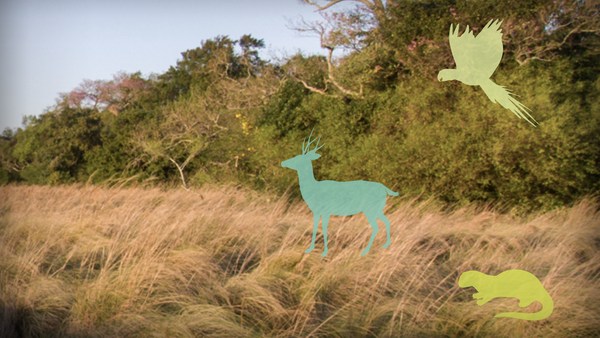
While a picture might be worth a thousand words, if we only focus on pictures, we might be missing the forest for the trees. When you look at a picture like this, you don't see any animal. But if you listen, the story is different.
(Animals vocalizing)
SPARROW has the ability to isolate and classify sounds. Here, for example, there's a frog.
(Frog croaks)
That's a cicada.
(Cicada buzzes)
That's a macaw.
(Macaw chatters)
Thanks to SPARROW, through sound, we can measure the true health of a forest.
Identifying an animal from a picture is not difficult. Identifying sound requires very deep expertise. People like Paula Caycedo from Fundación Biodiversa Colombia have this expertise. In every expedition, she collects 600 hours' worth of sounds. And then she listens to every one of these hours. This is like binge watching the whole complete eight seasons of “Game of Thrones” ten times --
(Laughter)
just to get a few samples of the animal she cares [for]. SPARROW can help people like Paula.
Paula can train SPARROW to focus on a particular animal or a particular call, so she can save hundreds of hours of her time, so she can focus on what she does best: having a better understanding and helping protect the animals she loves.
Because SPARROW is connected online, SPARROW can actually send alerts. Wildfires are a major global threat, costing lives, billions in infrastructure and the complete destruction of some of the most important biodiversity ecosystems. In a wildfire, every minute counts. Detect it early, and you can stop it with a shovel. But if you wait, you will need bulldozers, air tankers and sometimes a miracle.
SPARROW has the ability to do early detection of fire and send alerts to authorities. With SPARROW, we're not only collecting data, we can act on that data, and that data can help save lives.
By the end of 2025, we will have SPARROW running in all continents. SPARROW will change the way biodiversity data works. Today, conservation moves at the speed of data, and when a conservationist installs a device, to the time that it takes for that data to eventually get analyzed today, it takes months, sometimes a year. With SPARROW, we want to move from months to days. For some species, this difference, this delta, can be the difference between survival and extinction.
I dedicate this talk to the conservationists out there who have dedicated and even sacrificed their lives to help protect biodiversity on this planet. They might not wear capes, but make absolutely no mistake, they are superheroes. Yet they need our help. Our job, our responsibility, and our commitment today is that we will provide them with the best tools we can so they have a fighting chance.
Thank you.
(Cheers and applause)